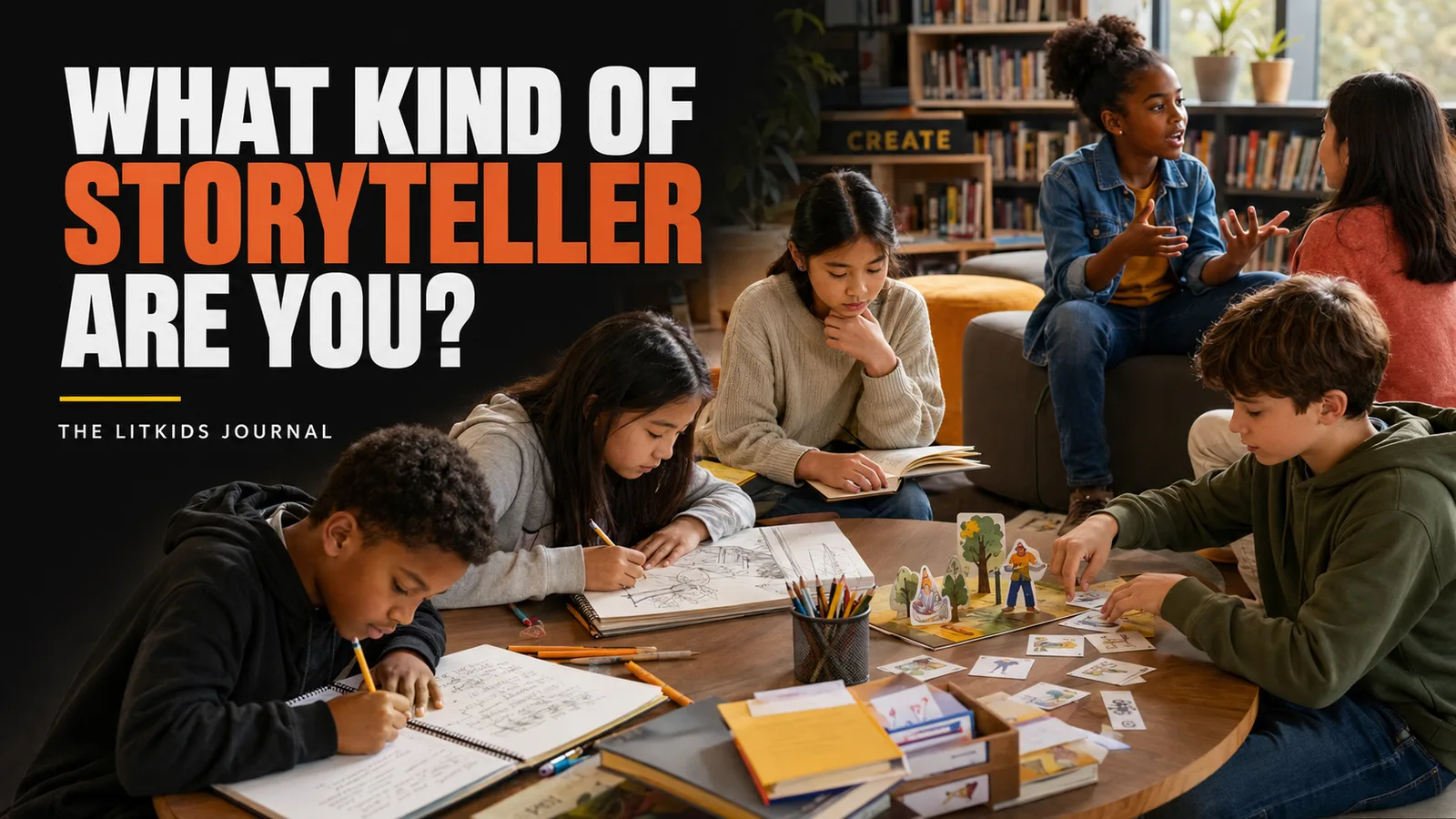
If you give five people the same creative challenge, you could end up with five entirely different approaches to starting. One person might immediately fill the page with a dozen different options. Another might begin by drawing what's in their mind's eye. A third might go quiet, because they need time to think. Yet another might reach for the materials and start creating even though they don't have a plan yet. And somewhere in the room, someone has already turned to the person next to them and said, "Okay, listen to my idea."
Everyone was given the same challenge, but each of them found a different way to start. When children see these differences named and understood, they feel appreciated — because it shows that their own way of expressing themselves matters. That's the reason the LitKids Storyteller Profile™ exists: to help us recognize those differences.
Storytelling Begins Before the Writing
When most adults picture a storyteller, they imagine someone sitting down with a notebook, writing a story from start to finish — neat, well-structured, a clear beginning, middle, and end, correctly spelled and punctuated.
Meanwhile, the real child might be on the floor running a battle between a superhero, a dinosaur, and a sock. That child is telling a story too — it just starts with action instead of writing.
Stories don't have to start with a sentence. A child might act out a full adventure while playing. They might draw a character before they've even given it a name. They might ask ten "what if?" questions, quietly imagine a whole scene, or start building something just to find out what the idea might become.
All of that is storytelling. Writing is one way to present a story — not the only way to access one. Creative expression can start in a lot of different forms.
When we understand how children naturally reach for ideas, we can support them as they move from imagination to expression without taking over. Adults want to help, and our intentions are good — but sometimes we already have the ending worked out before the child has finished explaining the beginning.
Understanding a child's creative process is what helps us tell the difference between support that's helping and support that's quietly becoming ours instead of theirs.
What Is the LitKids Storyteller Profile™?
The Storyteller Profile™ helps parents, teachers, and caregivers recognize how a child most naturally generates, explores, and expresses their ideas right now.
The Spark Starter™ is drawn to possibilities. The Visual Visionary™ usually needs to see the idea. The Quiet Genius™ works through ideas internally. The Story Hustler™ discovers ideas through action. The Story Connector™ builds stories through interaction.
There isn't a single "best" Storyteller Profile. It's not a diagnosis, a fixed personality type, or another label for a child. A child can show traits from more than one Profile, and their approach may shift depending on the activity, the environment, their confidence, or whether they've had a snack. (Hunger really can change a child's entire personality. Let's be honest.)
The Storyteller Profile™ isn't about sorting children into categories. It helps us notice their natural starting points, recognize the strengths they already bring, and support them as they build other ways of communicating and creating.
The Spark Starter™
A Spark Starter™ is energized by possibilities. They can quickly generate characters, settings, inventions, problems, or endings — one idea leading to another, until suddenly a dog that can fly is running a restaurant on Mars.
The page fills up fast, but nothing seems finished. An adult might read that as a lack of focus. Most of the time, the child is simply doing what comes naturally: exploring possibilities until one of them catches.
Spark Starters benefit from room to brainstorm and a simple way to capture ideas before they're lost. They may eventually need help choosing one idea to develop — but they shouldn't be rushed into a choice before they've had time to explore.
It isn't the adult's job to pick the "best" idea for the child. Instead, try noticing which ideas seem to excite them, and ask: "Which idea do you keep thinking about?" or "Which one are you most curious about?" The final creative decision still belongs to the child.
The Visual Visionary™
A Visual Visionary™ usually needs to see the idea first. They might start with a drawing, a character sketch, a map, a storyboard, a collage, a diagram, or an arrangement of objects — because seeing it is how they figure out what they want to say.
An adult might assume the child is drawing to avoid writing. Sometimes that's true — kids are smart, and they'll take an opening when they see one. But often the child is building the story through pictures, working out characters, setting, mood, relationships, and action before they're ready to turn any of it into sentences.
Visual Visionaries grow through the chance to sketch, map, arrange, and represent their ideas before or during writing. The drawing isn't always decoration. Sometimes it's where the story actually starts.
Instead of asking the child to stop drawing and start writing, try: "What's happening in this picture?" or "What does this drawing tell you about your story?" The words they need to start writing often come from their own answer.
The Quiet Genius™
A Quiet Genius™ forms ideas internally. They may need time to observe, imagine, and think before they're ready to answer a question or start creating. Quiet doesn't mean disengaged, confused, or out of ideas — often, they're working through the whole thing in their head.
Silence can feel uncomfortable to adults. We tend to wait about three seconds after asking a question before offering answers ourselves — a dog, a superhero, an adventure, maybe even a whole trilogy — and by then, we've built the story before the child finished finding their first idea.
Quiet Geniuses do well with time to think, calm encouragement, and the chance to respond when they're ready. Their ideas can still be forming even when nothing's been written down yet.
Try saying, "Take your time," or "Let me know when you're ready to share." That small bit of space communicates trust — it tells the child we believe they can get there on their own, without anyone rushing in to fill the silence for them.
The Story Hustler™
A Story Hustler™ generates ideas through action. They might grab paper and start writing, act out the scene, move the pieces, try the materials, or start building — even without knowing exactly where it's headed.
Their process can look unplanned from the outside, because it usually is. But a plan tends to show up as a result of taking action. They figure out what the story needs by trying something, watching what happens, and deciding what comes next.
Story Hustlers benefit from room to experiment, create, adjust, and learn as they go. They may need some help reflecting on what they've discovered — but they don't need a full outline before they're allowed to start.
Being a Story Hustler™ doesn't mean never planning, revising, or finishing — that would be a nice loophole, but it isn't a real one. A Storyteller Profile describes a natural starting point. It isn't a pass that excuses the rest of the process.
Adults can support Story Hustlers by letting them start, then helping them look back at what they made. A question like "What did you find out when you tried that?" helps turn action into a more deliberate creative decision.
The Story Connector™
A Story Connector™ brings stories to life through interaction. They may love talking, performing, reading aloud, working with others, or pulling people into imaginative play. They tend to form ideas by telling them to someone, watching how the listener responds, and developing the story from there.
Adults sometimes assume a child who talks about stories more than they write them isn't really a writer. But oral storytelling is a real form of storytelling. For many Story Connectors, the spoken version is their first draft — it's how they test lines, build scenes, watch reactions, and figure out what's actually working.
Story Connectors grow through engaged audiences, family storytelling, collaborative activities, and the chance to talk through their ideas. They also grow by practicing active listening, sharing the creative space, and making room for other people's voices too.
Try having a Story Connector tell the story before they write it, or record them telling it so they can listen back later. The goal isn't to replace writing — the conversation is a bridge that helps move their spoken ideas onto the page.
Why Your Own Storyteller Profile Matters
The Storyteller Profile™ isn't only about understanding children — it also helps you notice the expectations you bring into their creative process.
Adults tend to suggest what's worked for them. A Visual Visionary might tell a child to draw first. A Quiet Genius might expect the child to sit and think it through alone. A Story Connector might want to talk through every option. A Story Hustler might tell the child to stop overthinking and just start.
None of those instincts are wrong. The trouble starts when we assume our own pathway should work for every child — and when it doesn't, we mistake difference for difficulty.
We might decide a child is distracted, unprepared, resistant, or not trying, when really, they just need a different way in. A useful question for parents and teachers alike: "Am I meeting their way of working, or am I asking them to meet mine?"
That question can be uncomfortable to sit with — it was for me too. It can also change how we support children in a real way.
Supporting the Process Without Taking Over
You don't need to announce a child's Profile every time they start a creative activity. No need for, "You're organizing your pens. That's very Visual Visionary of you."
The Storyteller Profile™ is meant to make adults more responsive — to help us notice what a child might need without turning every creative moment into an analysis.
You might simply wonder: would they rather write, draw, talk, build, or think first? Do they want time alone, or someone to listen? Do they want a plan before they start, or do they want to start and figure out the details as they go?
Questions like these tell a child that their way of creating is valued. They also hand the child a real say in how the work gets done.
Supporting a child doesn't mean clearing every obstacle out of their way. Children still need the chance to choose, carry out, revise, share, and finish their own ideas. Responsive support starts with understanding how they get there — then deciding what kind of help actually fits.
A Profile Is a Starting Point, Not a Limit
A child can be a Story Connector™ and also show strong Spark Starter™ traits. A Visual Visionary™ might find it easier to think out loud. A Quiet Genius™ might get unstuck by acting out a scene.
The Storyteller Profile™ shows us how someone naturally creates today. It doesn't set the limits on who they might become tomorrow.
Children can build new creative skills while still holding onto confidence in the ways that already feel natural to them. The goal was never to get every child creating the same way. The goal is helping each child understand that their ideas matter, that their way of creating is valid, and that they can ask for help without giving up ownership of their work.
The story is the storyteller's.
What Kind of Storyteller Are You?
Some stories start as pictures. Others start as a question. Stories can be found through movement, through conversation, through experimenting, or through quiet imagination.
There's no single correct way to start a story. The first thing worth realizing is that your own ideas usually begin with you.
Once we understand that, there's no need to push every storyteller through the same approach. We can give children room to discover what they imagine, support them as their ideas grow, and help their stories reach the world — without ever taking the story over.
Ready to find out what your natural storytelling approach is?
Take the LitKids Storyteller Profile™ to see which creative approach feels most like you.
Take the LitKids Storyteller Profile™It's not about belonging to a single category. It's about finding your own voice — and every voice should be heard.